



Credit Accounts Available
Trade customer? Apply for a credit account

We're here for you
Have a question? Call us on 03301 239 828
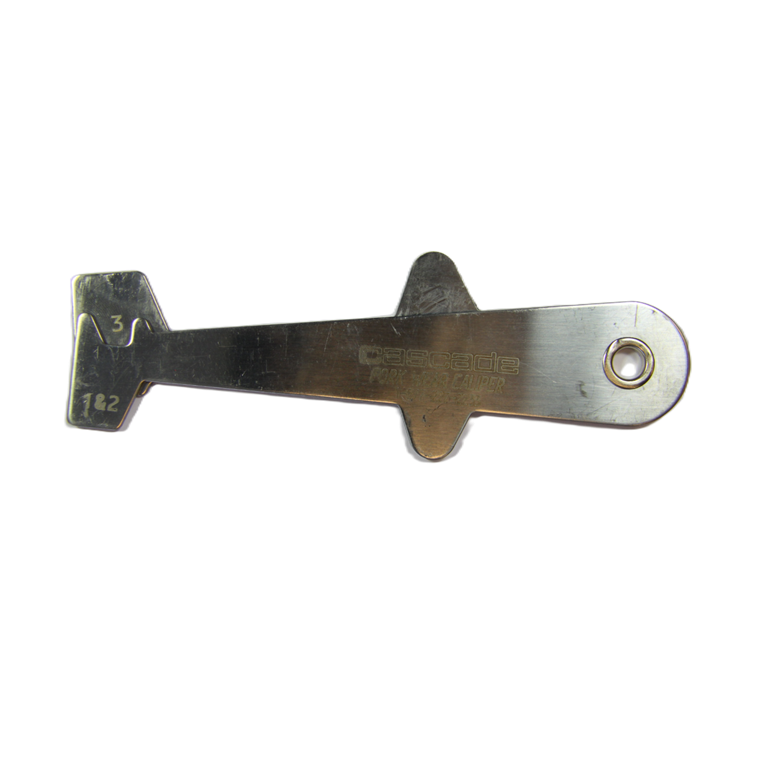
Fork Gauge (Caliper)
Product Code: DS012112
SKU: DS012112
£12.50 exc. VAT
Proper fork maintenance includes regular inspection to ensure forks are in good working condition.
With these 8 steps, the fork wear gauge makes it easy. See video for more information.
Step 1: Check Blade wear
To start set the front teeth of the caliper by measuring the thickness of the shank.
Ensure that the caliper is held square across the shank for an accurate reading.
Without changing the caliper setting, position the front teeth of the caliper over the fork arm blade to measure it's thickness
Ensure the measurement is taken near the heel of the fork within 40mm and 80mm from the front face of the fork shaft.
If any part of the caliper back teeth hit the fork blade it has less than 10% wear and can remain in service
If the back teeth of the caliper pass freely over the fork blade the fork arm shall be taken out of service. This indicates over 10% wear and 20% reduction in capacity
Step 2: Check the hooks or bushing for wear
Use the end of the caliper desiged for your fork class (class 1, 2 or 3) with a caliper positioned 20mm in from the side of the hook.
Slide the caliper into the hook pocket
If the hook lip contacts the back of the caliper the fork shall be removed from service
The fork wear caliper can also be used as inside calipers for measuring the bore or bushings on shaft pin type forks
Reverse the caliper and insert vertically into the bushing
Open the caliper until both teeth touch the inside wall of the bushing
Pull the caliper out and measure the distance between the tips of the teeth
Take this measurement twice, once near the inside edge of the bushing and once at a depth of at least 25% the length of the bushing.
If the two measurements differ by more than 3mm further inspection of the bushing is required.
If any deformation, cracks or thinning of the upper wall thickness are evident call our service line for assistance.
Step 3: Check the surface for cracks
Pay special attention to the fork heel and all welds which attach the mounting components to the fork plank
Forks with surface cracks should not be returned to service
Step 4: Check the blade and shank for straightness
First determine the allowable deviation as noted in the fork inspection guide
The allowable deviation is equal to five thousandths of the length of the blade or height of the shank or 0.5%
If the deviation from straightness exceeds this amount the fork shall not be returned to service until it's been repaired.
Step 5: Use fork gauge (caliper) to check the fork angle
Align the outside points of the caliper with the inside of the fork heel.
Make sure all four points make contact with the fork.
Check the angle of the fork using the indicator at the hinge of the caliper.
Forks that deviate from the allowable three degree values should be removed from service.
Step 6: Fork Tip Alignment
To ensure proper tip alignment use a tape measure to determine the maximum allowable tip difference, which is 3% of the fork plate length.
When the difference in the height of the tips of the pair of the forks on the same carriage exceeds this amount the forks must be removed from service.
Step 7: Check fork retention hardware
Check the positioning lock and other fork retention devices to ensure they're in place and in correct working order.
If the position lock is missing or non operational the forks shall be removed from service.
Step 8: Check fork identification
While you're inspecting the forks, make sure the fork identification is clearly legible.
If it's not the forks must be removed from service.
Note: This fork wear caliper can be used on forks up to and including 100mm thick
NOT FOR USE ON FULL TAPER OR TWO STAGE TAPER FORKS
Delivery and Returns
Please click on the link below to view our delivery and returns policy
×
{0}
Credit Accounts Available
Trade customer? Apply for a credit account
We're here for you
Have a question? Call us on 03301 239 828