

How to Choose the Right Winter Yard Equipment: A Buying Guide for Site & Facilities Managers
Getting caught out by the first cold snap of the year is a familiar problem for anyone responsible for a commercial site, a car park, warehouse yard, loading bay or set of pedestrian walkways that suddenly needs clearing before staff, visitors or delivery drivers arrive. The right equipment depends less on budget and more on the size and type of area you're treating. This guide walks through how to match your site to the right tools.
Start with your site, not the product list
Before comparing individual products, it helps to categorise what you're actually treating:
- Small, pedestrian-only areas: entrances, steps, short paths, fire exits
- Larger pedestrian routes: car parks, walkways, site paths covering a wider area
- Vehicle-accessible areas: yards, access roads, larger car parks that a towable unit can cover
- Bulk snow, not just ice: areas where snow needs physically moving, not just treating
Most sites need a combination of at least two of these, which is why a "buy one thing" approach rarely works. The right kit is usually a small hand tool for entrances plus one larger piece of equipment for everything else.
Small areas: salt scoops, shovels and de-icing salt
For entrances, steps and short paths, you don't need machinery. A salt scoop and de-icing salt cover this on their own, and a snow shovel handles any snow that needs clearing before salt goes down. This is the cheapest tier of the range and the one every site needs regardless of what else you buy, since even sites with a full mechanical gritter still need someone to treat the areas a machine can't reach.
Good for: entrances, fire exits, steps, narrow paths
Not suited to: anywhere with meaningful vehicle or foot traffic volume, hand application doesn't scale
Larger pedestrian and path areas: mechanical gritters
Once you're covering more ground than a scoop can realistically manage (a full car park, a network of site paths) a mechanical gritter (pedestrian-pushed) is the next step up. It spreads salt evenly and far faster than doing it by hand, without needing a vehicle to tow it.
Good for: car parks, site paths, walkways too large to treat by hand
Vehicle-accessible areas: towable salt spreaders
For yards, access roads and larger car parks, a commercial towable salt spreader covers significantly more ground per pass than a pedestrian gritter, because it's built to be towed behind a vehicle rather than pushed by hand. If your site has vehicle access to the areas that need treating, this is almost always the faster and more efficient option once the area gets beyond what a pedestrian gritter can reasonably manage in the time available before staff or deliveries arrive.
When selecting a towable unit, the main decision is painted steel vs stainless steel. Both do the same job; the difference is how well they hold up to repeated salt exposure over multiple seasons. If the gritter will be used heavily every winter and stored between seasons, stainless steel resists corrosion significantly better. If use is lighter or occasional, painted steel is a perfectly reasonable lower-cost option, just factor in that it won't hold up as well under heavy salt exposure.
Good for: yards, access roads, larger vehicle-accessible car parks
Requires: a vehicle capable of towing it
Choose stainless steel if: used heavily every season
Choose painted steel if: lighter or occasional use, lower upfront cost matters more
Bulk snow: fixed-blade or forklift-mounted ploughs
Salt and grit treat ice, they don't move snow. Once there's enough snow that it needs physically clearing before anything else can happen, you need a plough rather than a spreader.
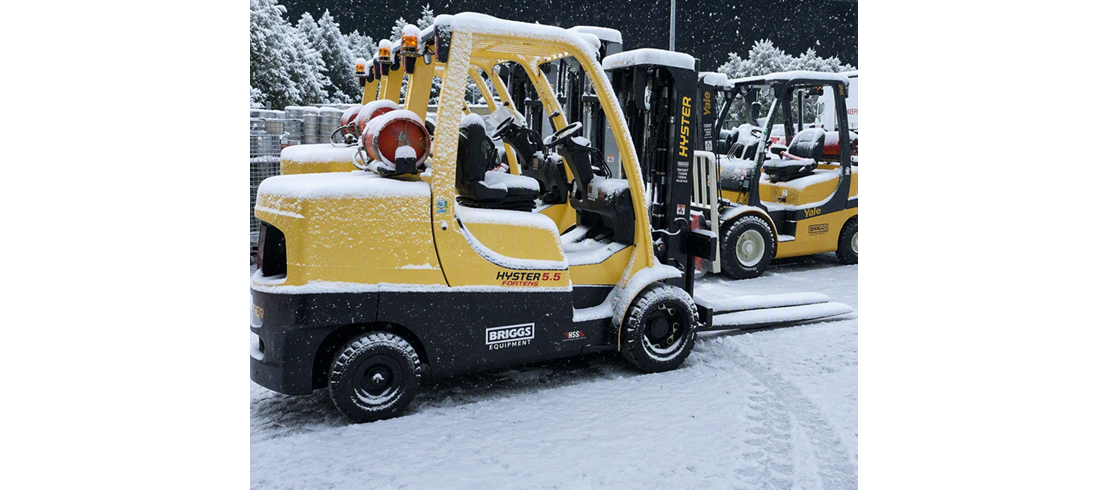
If your site already runs forklifts or handling equipment, a forklift-mounted plough lets you clear larger yard areas without needing a separate dedicated vehicle just for winter. You can choose between a fixed-blade model (which clears in one set direction) or an adjustable-blade model (which enables the plough to sweep left, right, or straight ahead for complete control over snow pile management).
Good for: sites that get meaningful snowfall, not just ice
Forklift-mounted is worth it if: you already operate a forklift on site and want to avoid buying a second vehicle just for winter clearance
Don't overlook storage
Salt and grit lose effectiveness if they clump or get damp, which is exactly what happens if they're left exposed to the weather between uses. A waterproof storage box is a small line item next to a gritter or spreader, but it protects the ongoing cost of your salt supply and means it's ready to use the moment you need it rather than needing to be dried out or replaced.
Buying vs short-term hire
If this is a one-off season, a trial, or you're not yet sure how much equipment your site actually needs, it's worth checking hire availability before committing to a purchase — larger items like gritters and spreaders don't need to be bought outright if you only need them for a short period. It's a useful way to test what works for your site before investing.
Quick summary
Site type | Best starting point |
|---|---|
Entrances, steps, small paths | Salt scoop, de-icing salt, snow shovel |
Car parks / paths (pedestrian) | Mechanical gritter |
Yards / access roads (vehicle) | Towable commercial salt spreader (stainless for heavy use, painted for occasional) |
Heavy snowfall, bulk clearance | Forklift-mounted snow plough (fixed or adjustable blade) |
Any of the above, ongoing | Waterproof storage box to protect your salt supply |
Most sites end up combining two or three of these rather than relying on a single product, a hand tool for the areas machinery can't reach, plus one larger piece of kit sized to the area it needs to cover.
Stay Ahead of the Freeze with Briggs Equipment
Preparing your site for harsh winter conditions is a critical safety responsibility that protects your staff, visitors, and operational continuity. By assessing your facility's specific layouts, from pedestrian entrances to high-traffic vehicle yards, and investing in the right combination of spreaders, shovels, and forklift attachments, you ensure your site remains safe, compliant, and accessible no matter the weather.
At Briggs, we stock a comprehensive range of winter site maintenance equipment, including pedestrian gritters, towable spreaders, heavy-duty forklift snow ploughs, and weatherproof salt bins. Supported by our nationwide network of over 600 UK-based engineers, we provide the reliable equipment and expert guidance you need to keep your business moving all year round.
Ready to prepare your site for winter?
Browse our complete winter maintenance range today.